CLASS 9TH DAY 4

INTRODUCTION

sound

Everyday we hear sounds from various sources like humans, birds, bells, machines, vehicles, televisions, radios etc. Sound is a form of energy which produces a sensation of hearing in our ears. There are also other forms of energy like mechanical energy, heat energy, light energy etc. There is a law of conservation of energy, which states that we can neither create nor destroy energy, we can just change it from one form to another.


When you clap, a sound is produced. Can you produce sound without utilizing your energy? Which form of energy did you use to produce sound? Today we are going to learn how sound is produced and how it is transmitted through a medium and received by our ear.

Production of Sound

Sound is produced when an object vibrates (moves back and forth rapidly). In other words, sound is produced by vibration of objects. Let’s see this with the help of following activities.

Activity 1: Keep your hand on your throat while speaking. You can feel the vibration of your vocal cords.

Activity 2:

  1. Take a balloon and blow it up.
  2. Hold the balloon against your friends ears and press your lips against the balloon and speak.
  3. You can hear the vibration through the balloon and feel them.

In this case the balloon’s surface vibrates creating sound waves.

Activity 3:

  1. Take a sling wrap, place it (As shown in the figure, you can skip the food though, :-D), stretch it and then stitch it tightly on the top of a steel can. You can use a rubber band to keep the wrap in place.
  2. Take some puffed rice (also known as muri or laiyya) and keep them on the wrap.
  3. Take a steel plate and hold it near the puffed rice.

Tap the steel plate with a wooden stick or ruler.

Steel plate vibrates when it is hit with the ruler. This makes the air around it vibrate too. The vibrations pass through the air and make the stretched wrap to vibrate as well. This makes the puffed rice move. That means sound is created when an object moves and air around it vibrates creating sound waves.

Activity 4:

  1. Take 6 to 8 bowls or tumblers
  2. Fill them up with water at different levels, increasing gradually from one end to the other, that is, the water level in the second bowl or tumbler should be more than the first one, and so on.
  3. Now take a pencil or spoon and strike the bowls gently.
  4. Strike all of them in succession.
  5. You will hear pleasant sounds.

The air in the bowl or tumbler vibrates when we strike with pencil or spoon, making sound waves.

Sound is produced by vibration of objects. Vibration means a kind of rapid to and fro motion of an object. The sound of the human voice is produced due to vibrations in the vocal cords.

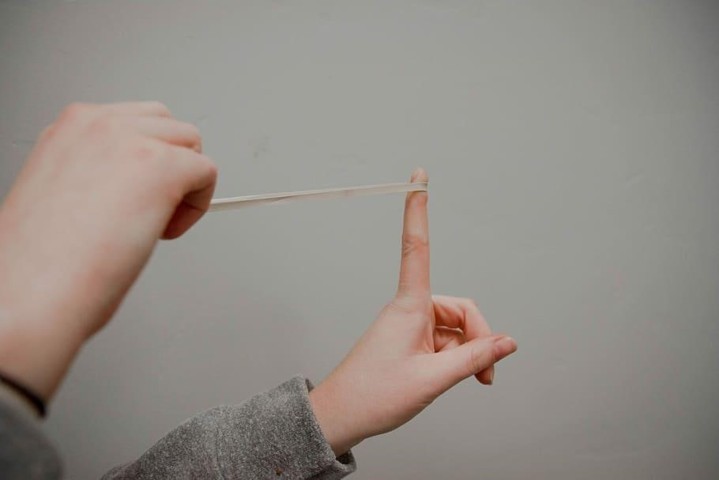
When a bird flaps its wings, do you hear any sound? Think how the buzzing sound accompanying a bee is produced. A stretched rubber band when plucked vibrates and produces sound. If you have never done this, then do it and observe the vibration of the stretched rubber band.

Click below to if you have any trouble performing the above mentioned activities👇 👇 

Propagation of Sound

The travelling of sound is called propagation of sound.Sound is propagated by the to and fro motion of particles of the medium. So, sound is produced by to and fro motion of the object and it propagates by the to and fro motion of the particles of the medium. The matter or substance through which sound is transmitted is called a medium. It can be solid, liquid or gas.

Sound moves through a medium from the point of generation to the listener. When an object vibrates, it sets the particles of the medium around it vibrating. The particles do not travel all the way from the vibrating object to the ear. A particle of the medium in contact with the vibrating object is first displaced from its equilibrium position. It then exerts a force on the adjacent particle.

As a result of which the adjacent particle gets displaced from its position of rest. After displacing the adjacent particle the first particle comes back to its original position. This process continues in the medium till the sound reaches your ear. The disturbance created by a source of sound in the medium travels through the medium and not the particles of the medium.

‘Only the disturbance produced by the vibrating body travels through the medium but the particles do not move forward themselves.’

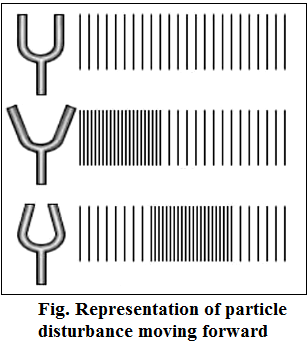
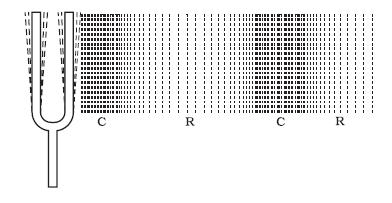
When a vibrating object moves forward, it pushes and compresses the air in front of it creating a region of high pressure. This region is called a compression (C), as shown in figure. This compression starts to move away from the vibrating object. When the vibrating object moves backwards, it creates a region of low pressure called rarefaction (R), as shown in figure. As the object moves back and forth rapidly, a series of compressions and rarefactions is created in the air.

These make the sound wave that propagates through the medium. Compression is the region of high pressure and rarefaction is the region of low pressure. Pressure is related to the number of particles of a medium in a given volume.

To learn more about propagation of sound, click below👇 👇 

What is a wave?

A wave is a disturbance that moves through a medium when the particles of the medium set neighboring particles into motion. Since sound waves are characterized by the motion of particles in the medium, they are Mechanical Waves.

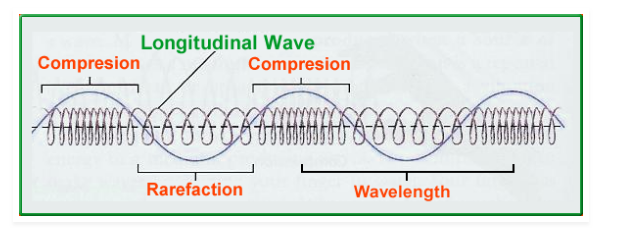
There are two types of Mechanical Waves, Longitudinal and Transverse.  Sound is a Longitudinal Wave.

Longitudinal waves – In this type of wave, the movement of the particle are parallel to the motion of the energy i.e. the displacement of the medium is in the same direction to which the wave is moving. Example – Sound Waves, Pressure Waves.

Characteristics of a sound wave:

Following are the main characteristics of sound wave:

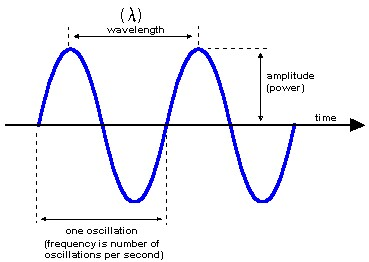
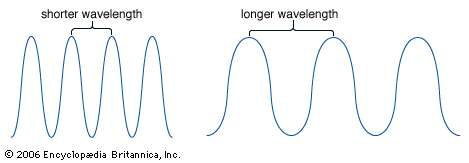
Wavelength: Wave length is the length between two consecutive compressions (C) or two consecutive rarefaction (R). Wavelength is represented by Greek letter λ (lambda). Louder sound has shorter wavelength and softer sound has longer wavelength. The SI unit of wavelength is metre (m).

Amplitude: The magnitude of the maximum disturbance in the medium on either side of the mean value is called the amplitude (A) of the wave.

Frequency:The number of oscillations per unit time is called the frequency of oscillation.The SI unit is Hz (Hertz) and is represented by ν (nu).

Time period: Time period (t) is the time taken for one complete oscillation. In other words, time in which a wave moves a distance equal to its wavelength is called time period.i.e. t = 1/v.

Velocity (Speed) :Distance covered by sound wave in unit time is called the velocity of sound wave.

Pitch: The frequency of vibration determines the shrillness or pitch of a sound. If the frequency of vibration is higher we say that the sound is shrill and has a higher frequency. If the frequency of vibration is lower, we say that the sound has a lower pitch. For example, a whistle produces a very shrill sound.

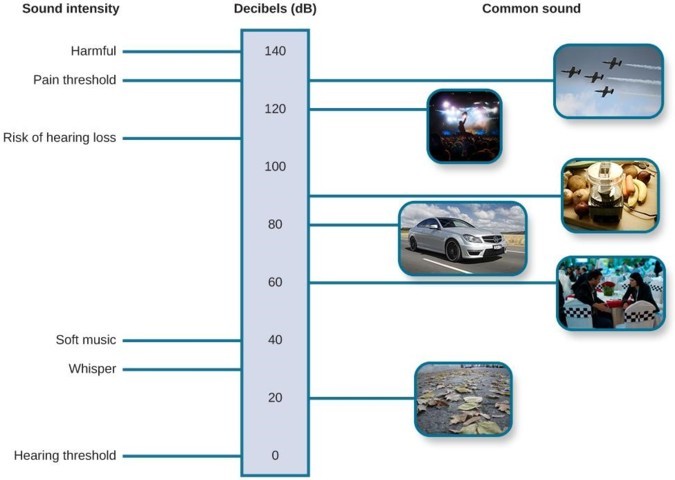
Loudness: Loudness of sound is proportional to the square of the amplitude of the vibration producing the sound. For example, if the amplitude becomes twice, the loudness increases by a factor of 4. Loudness is expressed in a unit called decibel. Its symbol is dBWhen the amplitude of vibration is large, the sound produced is loud.When the amplitude is small, the sound produced is feeble.

Intensity of sound: The amount of sound energy passing each second through a unit area is called the intensity of sound. Loudness and intensity are not the same. Loudness is a measure of the response of the ear to the sound. Even when two sounds are of equal intensity, we may hear one as louder than the other simply because our ear detects it better.

Quality or timber of sound: The quality or timber of sound is that characteristic which enables us to distinguish one sound from another having the same pitch and loudness. The sound which is more pleasant is said to be of a rich quality. A sound of a single frequency is called a tone. The sound which is produced due to a mixture of several frequencies is called a note.

Speed of sound: Speed of the sound waves is the ratio of distance to time. It is denoted by the letter ‘v’. The speed of a sound wave depends on the properties of the medium through which it propagates.

speed = wavelength/time

speed = wavelength × frequency

To learn more about the characteristics of sound wave, click below

Speed of Sound in Different Media: Sound propagates through a medium at a finite speed. The sound of a thunder is heard a little later than the flash of light is seen. So, we can make out that sound travels with a speed which is much less than the speed of light.

The speed of sound depends on the properties of the medium through which it travels. You will learn about this dependence in higher classes. The speed of sound in a medium depends on the temperature of the medium. The speed of sound decreases when we go from solid to gaseous state. In any medium as we increase the temperature the speed of sound increases. For example, the speed of sound in air is 331 m s–1 at 0ºC and 344 m s–1 at 22ºC. The speeds of sound at a particular temperature in various media are listed in Table.1. You need not memorize the values.

Speed of sound in different media at 25 ºC

State

Substance

Speed in m/s

Solids

Aluminium 6420

6420

Nickel

6040

steel

5960

Iron

5950

Brass

4700

Glass (Flint)

3980

Liquids

Water (Sea)

1530

Water (distilled)

1498

Ethanol

1207

Methanol

1103

Gases

Hydrogen

1284

Helium

965

Air

346

Oxygen

316

Sulphur dioxide

213

Sonic Boom

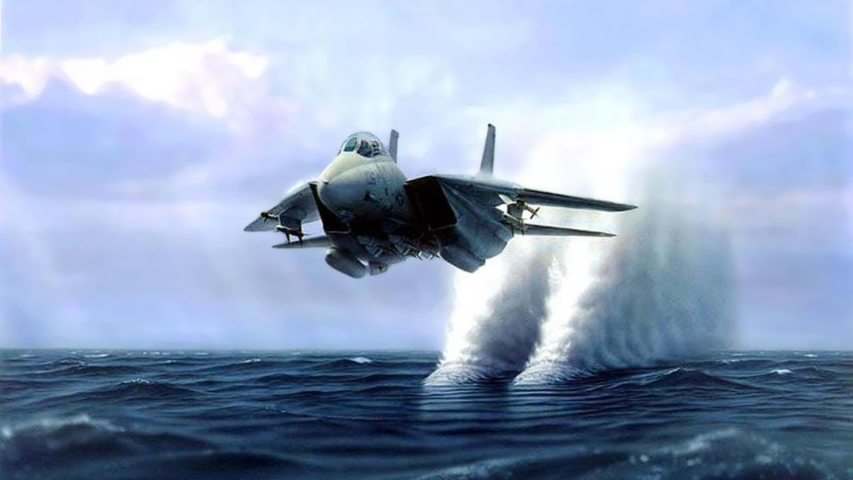
When the speed of any object exceeds the speed of sound it is said to be travelling at supersonic speed. Bullets, jet aircrafts etc. often travel at supersonic speeds. When a sound, producing source moves with a speed higher than that of sound, it produces shock waves in air.

These shock waves carry a large amount of energy. The air pressure variation associated with this type of shock waves produces a very sharp and loud sound called the “sonic boom”. The shock waves produced by a supersonic aircraft have enough energy to shatter glass and even damage buildings.

To learn more about sonic boom, click below👇 👇 

WHAT IS GOING AROUND IN THE WORLD?

Gk is the king of all knowledge .This is because , if you have a strong general knowledge , then you are well aware of the surrounding world .

Lets see how much aware you are ?

Puzzles

Its fun time now, try solving these logic puzzles.

JIVAN GYAN

-----FUN & LEARN-----